
Data Analyst vs Data Engineer
Different workloads, similar value
Many organizations struggle with the difference between data analysts and data engineers when building their teams.
This confusion leads to wrong hires, frustration within teams, and missed opportunities to get the most out of data.
In Belgium, CIOs and data managers are increasingly looking for clarity: which role brings which value, and when do you need who? This guide provides concrete insights to help you make better team decisions.
Table of contents
- What is a data analyst?
- What does a data engineer do?
- Differences and similarities between a data analyst and a data engineer
- How do you choose the right talent for your data team?
- Strengthen your data team with Dark Light
- Frequently asked questions about data analysts and data engineers
Key insights
| Point | Details |
|---|---|
| Fundamentally different focus | Data analysts focus on interpretation and reporting; engineers focus on infrastructure and data pipelines |
| Very different technical requirements | Analysts work with SQL and visualization tools; engineers work with Python, Spark, and cloud platforms |
| Salary levels vary significantly | A lot of variables influence pay in Belgium; industry, responsibilities, hybrid work, project duration, etc. |
| Complementary team roles | Both functions strengthen each other in data-driven organizations that want scalable analysis |
| Strategic hiring is crucial | Choosing the wrong role slows down projects; the right match accelerates business results |
What is a data analyst?
A data analyst turns raw numbers into useful insights that support business decisions. These professionals dive into datasets to discover patterns, identify trends, and answer concrete business questions. They translate complex data into clear stories that stakeholders can understand and act on.
Core responsibilities include exploring data, performing statistical analysis, and creating dashboards that give real-time insight into business processes.
Data analysts work closely with different departments to understand their information needs and develop suitable reports.
Typical tasks and skills of a data analyst:
- Writing SQL queries to retrieve and filter data from databases
- Building interactive dashboards in tools like Power BI, Tableau, or Qlik
- Performing statistical analyses to discover correlations and cause-and-effect relationships
- Presenting findings to management with clear visualizations
- Working with business teams to define and monitor KPIs
- Using Excel for quick ad hoc analyses and reports
- Applying data cleaning techniques to ensure quality
The best data analysts combine technical skill with strong communication abilities. They not only know how to analyze data, but also how to translate their findings into actionable recommendations.
Critical thinking helps them ask the right questions before diving into an analysis.
Tip: An effective data analyst always starts by defining the business question before opening any tools. This prevents you from getting lost in interesting but irrelevant analyses.
The tool stack of an analyst is relatively accessible compared to engineering roles. SQL forms the foundation, combined with one or more visualization platforms and basic knowledge of statistical methods.
Some analysts expand their skills with Python or R for more advanced analyses, but this is not always required for day-to-day work.
What does a data engineer do?
Data engineers build and maintain the technical infrastructure that makes data analytics possible. While analysts use data, engineers make sure that data is available, reliable, and efficiently accessible.
They design data pipelines that collect, transform, and store information from various sources in formats that are easy to analyze.
This work requires deep technical knowledge of programming languages, databases, and cloud platforms. Data engineers have skills that go beyond simply working with data — they architect complete systems that are scalable and maintainable.
Core responsibilities of a data engineer:
- Designing and implementing ETL processes that move data from sources to warehouses
- Building real-time streaming pipelines for continuous data processing
- Optimizing database queries and data models for performance
- Implementing data governance and security policies
- Monitoring data quality and resolving pipeline issues
- Working with cloud platforms such as AWS, Azure, or Google Cloud
- Documenting data architecture and processes for team alignment
Salary landscape for data engineers in Belgium
The salary of data engineers in Belgium varies significantly depending on experience, company type, and whether the role is in consulting or industry. While high salaries exist, they are typically limited to senior or specialized profiles.
Typical salary ranges (Belgium)
| Experience Level | Salary Range (Belgium) | Typical Skills |
|---|---|---|
| Junior | €40,000 – €70,000 | SQL, Python basics, data modeling fundamentals, basic cloud exposure |
| Mid-level | €55,000 – €85,000 | Spark or dbt, strong SQL, data pipelines, one cloud platform (often Azure) |
| Senior | €80,000 – €120,000+ | Architecture, distributed systems, multiple tools, stakeholder management |
Salaries above €100k are possible but usually correspond to:
- senior or lead roles
- consulting environments
- niche expertise (e.g. data platforms, real-time systems)
Compensation in Belgium often includes extra-legal benefits (company car, bonuses, net allowances), which are an important part of the total package.
Differences and similarities between a data analyst and a data engineer
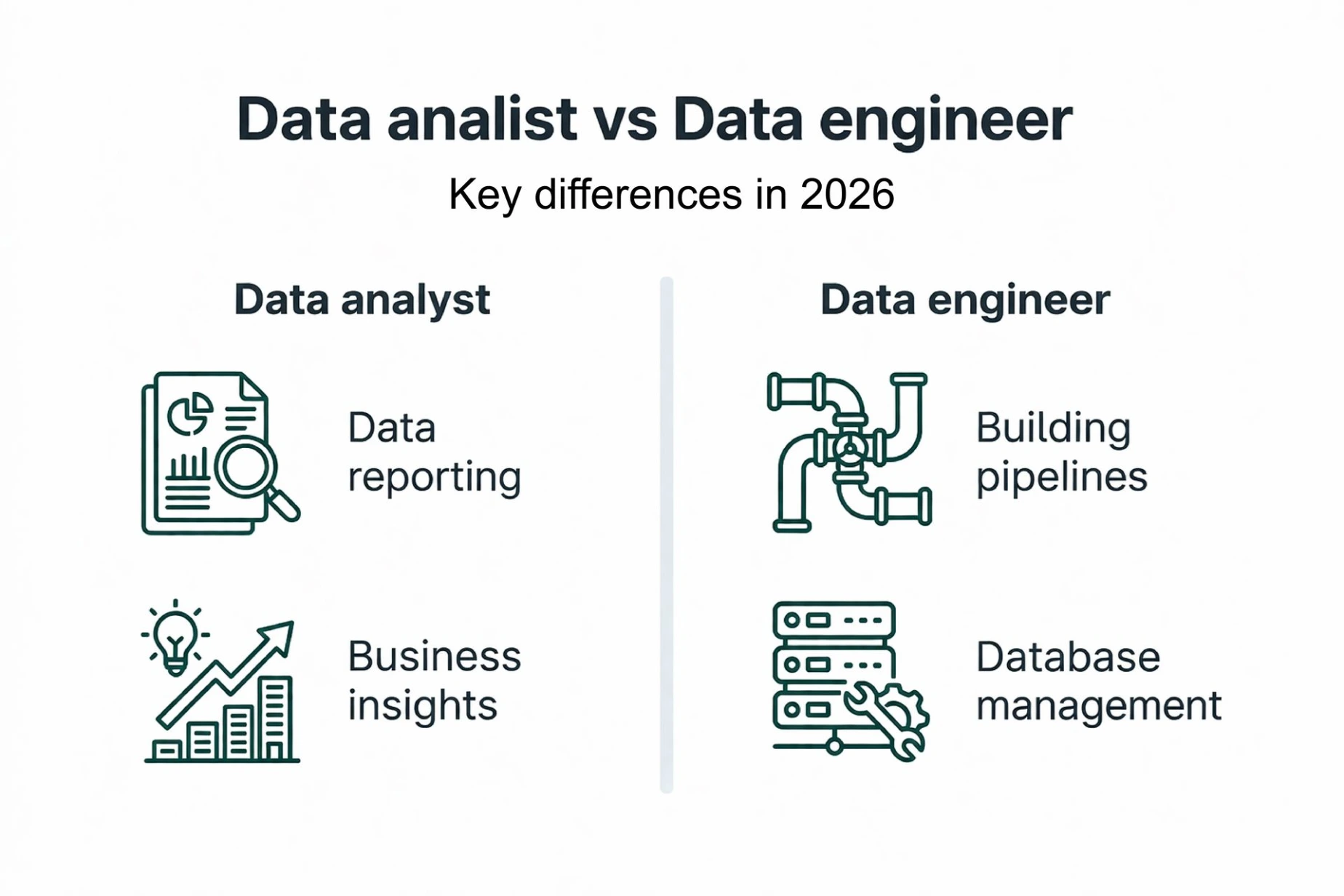
The roles have different areas of focus but together form the foundation of a data-driven organization. Data analysts consume and interpret data to generate business insights.
Data engineers produce and manage the infrastructure that delivers that data. This complementarity makes both roles essential.
| Aspect | Data Analyst | Data Engineer |
|---|---|---|
| Primary focus | Data analysis and reporting | Data infrastructure and pipelines |
| Technical depth | Medium: SQL, visualization tools | High: programming, cloud, architecture |
| End product | Dashboards, reports, insights | Data warehouses, pipelines, platforms |
| Interaction | Directly with business stakeholders | Mainly with technical teams |
| Tools | Power BI, Tableau, Excel, SQL | Python, Spark, Kafka, Airflow, cloud services |
| Average salary in Belgium | €55,000 – €75,000 | €95,650 average |
Skills overlap in certain areas, mainly around SQL and basic knowledge of data modeling. Both roles require an understanding of how databases work and how data is structured. The difference lies in the depth: analysts use SQL for queries, engineers use it for performance tuning and complex transformations.
When organizations effectively combine both roles:
- Engineers build reliable data pipelines that analysts can trust
- Analysts give feedback on data quality issues that engineers can resolve
- Teams deliver faster because each person focuses on their core expertise
- Projects scale better because the technical foundation is solid
- The business gets both stable infrastructure and valuable insights
Career paths show interesting patterns. Data analysts often move into business intelligence or data science roles if they go deeper into statistics. Engineers can grow toward data architect or platform engineer positions. Salary differences reflect this progression, with senior engineers earning significantly more than junior analysts.
A common misconception is that one person can fill both roles. While some professionals have broad skills, each function requires so much specialization that true expertise in both is rare. Small organizations sometimes ask for hybrid profiles, but this often leads to compromises in quality on both sides.
How do you choose the right talent for your data team?
The decision between a data analyst and a data engineer starts with identifying your organization's primary data needs.
Ask yourself concrete questions about current bottlenecks and future ambitions. This self-reflection prevents costly mistakes in recruitment.
Follow these steps to make the right choice:
- Analyze your current data situation: do you have reliable data but lack insights, or do you not have a solid data infrastructure?
- Identify concrete project goals: do you want to build dashboards or create data pipelines?
- Assess your existing team: which skills are missing and which are already present?
- Determine your budget and timeline: engineers cost more but build foundations that last a long time.
- Consider scalability requirements: growing data volumes require engineering expertise.
- Check your technical complexity: legacy systems and diverse data sources require engineering capacity.
If your organization already collects data but struggles to get value from it, start with a data analyst. This professional can quickly create wins by analyzing existing data and setting up reports. Management sees concrete results and the business case for further data investments becomes stronger.
When your data platform is fragile, pipelines fail regularly, or scalability is a challenge, prioritize a data engineer. Without solid infrastructure, analysts will keep fighting data quality problems and limited access. The engineer fixes these fundamental issues so the whole team becomes more efficient.
Tip: Work with specialized recruitment partners who understand the difference between both roles. General recruiters often miss the nuances that make a candidate truly fit your specific needs.
When screening candidates, test not only technical skills but also cultural fit and communication abilities. A brilliant engineer who cannot explain why certain architectural choices are important creates friction in teams. An analyst who does not dare to ask questions to stakeholders misses crucial context for their analyses.
Consider staffing solutions for projects with uncertain scope or temporary capacity needs. This lets you experiment with both roles before making permanent commitments. You learn what your organization really needs by seeing people in action.
FAQ
Data analysts spend their day exploring datasets, building reports, and presenting insights to business teams. They work mainly in SQL, Excel, and visualization tools to find patterns that support decisions.
Data engineers, on the other hand, write code for data pipelines, troubleshoot infrastructure issues, and optimize database performance. Their work is more technical and less visible to end users, but it forms the foundation on which analysts build.
In theory, a professional can develop broad skills that cover both areas. In practice, this hybrid approach often leads to compromises because each role requires deep specialization.
Small startups sometimes ask for this combination for budget reasons, but effectiveness decreases as projects become more complex. It is more effective to have both roles working closely together than to have one person do both.
Data analysts often grow into senior analyst, business intelligence specialist, or data scientist roles if they add machine learning skills. Some move toward product or strategy functions where data interpretation is key.
Data engineers evolve into senior engineer, data architect, or platform engineering positions. Both can grow into management roles such as Head of Data or Chief Data Officer, depending on their interest in leadership versus technical depth.
If you already have sources collecting data but do not know what to do with it, start with a data analyst for quick insights. If your data platform does not exist or is chaotic with many separate systems, invest first in a data engineer to lay the foundations.
Most organizations that are serious about data will eventually need both, but the starting order depends on where your biggest pain is.
For analysts: inability to explain technical findings in business language, no examples of impactful analyses, or too much focus on tools without understanding statistics.
For engineers: no experience with production systems, insufficient understanding of data modeling principles, or lack of interest in code quality and documentation. For both roles: poor communication skills or no curiosity about new technologies and methods.
Recommendations
- Data Engineer Skills: Tools, Technologies and Mindset
- Dark Light | Staffing Data & Business intelligence Projects
- News | dark-light
- Demand for AI Engineers | Dark Light
- Rol van data in logistiek: Efficiëntie, transparantie en klantgerichtheid
- Waarom AI en narrowcasting de perfecte match zijn - DPM Signage | Narrowcasting & Digital Signage